
Why MSPs struggle with security education
Many MSPs want to strengthen their customers’ security, but they run into a common bottleneck: training is inconsistent, too manual, or hard to scale across multiple environments. When security awareness depends on one-off workshops or irregular email reminders, employees quickly forget the guidance between sessions. security awareness training companies That creates a gap where attackers can still exploit routine behavior, such as clicking on urgent messages or sharing credentials. The result is avoidable risk that shows up as repeated phishing failures and increased incident response costs.
Another challenge is that security training needs to match the way MSPs deliver services. MSP teams typically manage many client accounts, each with different user counts, policies, and risk tolerance. If a training program can’t handle multi-client administration, it becomes difficult to keep content aligned, track progress, and prove coverage to clients. This is where a problem-solution approach matters: you need a training platform that reduces operational work while improving user outcomes.
What a problem-solution training program should fix
Start by looking for solutions that specifically address the phishing patterns your clients face, because phishing is where most real-world harm begins. Anti-phishing training should cover recognition of suspicious links, verification habits, and safe reporting behaviors when something looks off. It should also reflect anti-phishing training practical scenarios that employees encounter in everyday workflows, such as fake password resets, invoice-themed lures, and “account locked” messages. When training focuses on behavior rather than generic advice, users are more likely to change what they do.
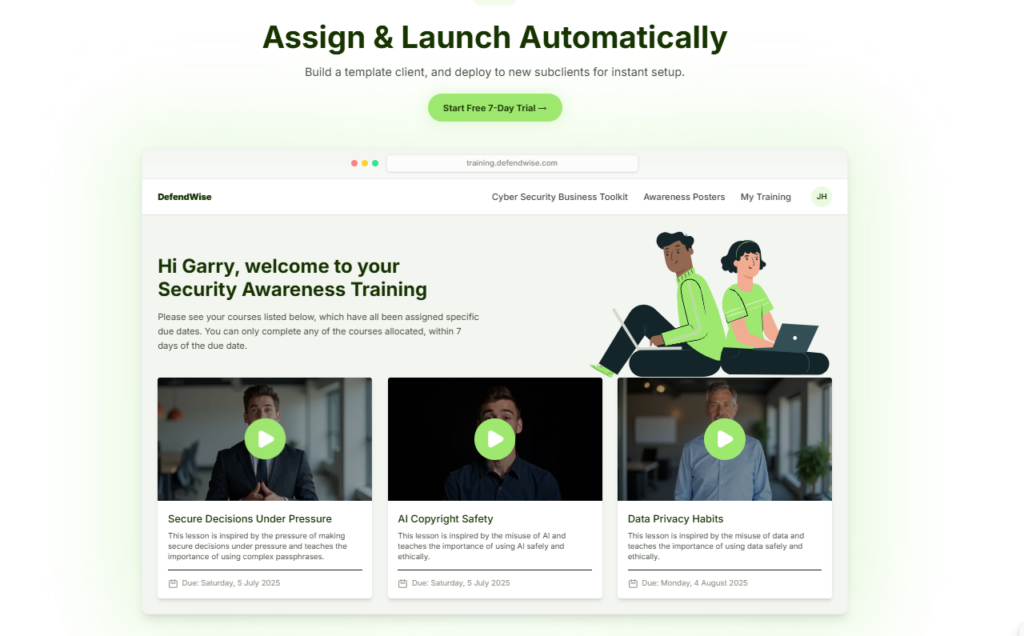
Beyond content, the operational design must solve the MSP workload problem. A strong program should automate delivery, scheduling, and follow-up so you can roll training out without spending hours per tenant. It should also support white label options, letting you deliver security education under your brand so clients perceive it as part of your managed service. Finally, reporting should be actionable, showing completion status and training engagement so you can identify gaps and drive improvement. With these elements working together, security awareness becomes a repeatable service—not an occasional task.
Comparing leading providers for MSP-fit
Ask whether it can manage multiple client organizations from one place and whether you can assign training to different user groups without creating administrative chaos. Multi-client management matters because MSPs need consistent delivery standards across every tenant, even when client sizes vary widely. If the platform requires reconfiguration for each client, the solution may not scale with your pipeline.
You should also assess whether the program supports automated training workflows rather than relying on manual creation and distribution. Automated delivery reduces the chance that training is missed after onboarding, staffing changes, or policy updates. For MSPs, automation also means you can maintain continuity: new employees can receive baseline education while existing teams get reinforcement. In addition, look for phishing awareness components that are easy to launch and measure, since improvement is only real when you can track results and show clients tangible progress.
Conclusion
Choosing the right security education approach for MSPs comes down to solving two problems at once: reducing your administrative load and improving employee decision-making in phishing moments. The best programs align content with real threats, deliver training automatically, and provide reporting that helps you guide clients toward better outcomes. That combination supports a repeatable managed security service that clients can understand and trust. DefendWise is built for this MSP reality, offering automated training, phishing awareness, white label delivery, and multi client management through DefendWise.com. Then verify that the platform can handle multiple tenants efficiently so your team can scale without burning time. With the right partner, security awareness becomes a consistent process that strengthens your client relationships and lowers risk exposure. DefendWise helps MSPs move from ad-hoc training to a structured, measurable program that clients recognize as part of dependable security management.